Ungrounded Reaction Wheel Neurorehabilitation
Mitti replaces rigid orthotic bracing with ungrounded angular momentum (T = I · α), 100 Hz Dual-IMU intention gating, and Assist-as-Needed kinesthetic stimulation for pediatric patients with hypotonia.
Core Biomechanical Rationale & Physics
Why ungrounded reaction wheels represent a paradigm shift over conventional exoskeletons and passive corsets.
Ungrounded Torque Generation
Traditional assistive devices are grounded: they push against the floor or brace adjacent limbs with rigid mechanical exoskeletons. This severely restricts natural joint degrees of freedom and induces muscle disuse atrophy.
Mitti generates ungrounded torque purely through the angular acceleration of spinning flywheel rotors mounted on the torso. The child experiences pure corrective rotational moments without any rigid grounding structures or joint constraints.
- ✓ Complete anatomical freedom of movement
- ✓ Lightweight wearable form factor (<250g per flagship module)
- ✓ Instantaneous dynamic response without structural backlash
Active Kinesthetic Cueing & Assist-as-Needed
Aligned with the clinical principles of Dynamic Movement Intervention (DMI), Mitti does not carry the patient's body weight. Instead, it provides brief tactile cues to stimulate the child's own proprioceptive reflex arc.
When a deviation is sensed, a brief torque impulse cues the central nervous system, prompting the child to actively recruit stabilizing trunk muscles and fostering authentic neuroplastic motor learning.
Pulsed Sawtooth Dithering
Continuous pressure leads to sensory habituation (neural adaptation). Mitti utilizes an asymmetric pulsed sawtooth profile with asynchronous phase resets to maintain neural alertness without sensory fatigue.
100 Hz Dual-IMU APA Intention Gating
How Mitti distinguishes voluntary pediatric movement from involuntary falls, eliminating unwanted resistance while providing immediate fall arrest.
Dual-IMU Differential Kinematics
Mitti continuously samples two synchronized 6-DoF IMUs: the Thoracic Spine Hub (Modul 1) and the Pelvic Reference Unit (Modul 5), broadcasting pose estimates via ultra-low latency ESP-NOW (<10ms).
- Differential Inclination: Computes Δθ = θhub - θpelvis to isolate true spinal flexion from hip bending.
- Differential Angular Velocity: Computes Δω = ωhub - ωpelvis to detect sudden postural collapse.
- Zero Inter-Module Drift: Bi-directional time-synchronization eliminates phase jitter across the torso.
Anticipatory Postural Adjustments (APAs)
Assist-as-Needed control requires that assistive torque never fights the child's intentional exploration. Voluntary reaching is always preceded by feedforward pelvic weight shifts.
- Voluntary Motion (1.6× Deadband): Pelvic acceleration precursor (0.15 ≤ |alat| ≤ 2.5 m/s²) latches a 250ms voluntary window, widening the deadband by 1.6× for complete movement freedom.
- Involuntary Stumble (0.6× Deadband): Sudden spine jerk (|jspine| ≥ 15 m/s³) or angular acceleration (|Δω̇| ≥ 250°/s²) without pelvic shift instantly contracts the deadband by 0.6× for immediate fall arrest.
Trapezoidal Neuromuscular Pulse Shaping
Accommodates peripheral demyelinating conduction delays (~200 ms latency) without triggering oscillatory stretch reflex recoil or joint capsule shock.
- 50 ms Jerk-Limited Ramp: Constrains dT/dt ≤ 30 Nm/s to protect pediatric cartilage and soft tissue.
- 150–300 ms Sustained Plateau: Bridges the 200 ms reflex delay so proprioceptive feedback stays coherent during active motor recruitment.
- 100 ms Controlled Ramp-Down: Eliminates antagonist reflex rebound and contralateral postural overshoot.
6-Module Hardware Architecture
A modular, distributed embedded architecture engineered for pediatric clinical safety, low latency, and agile hardware iteration. Backed by centralized data models (src/data/hardwareModules.ts).
The Hub
Gathers high-frequency thoracic kinematics, executes real-time postural orientation filtering and PID stabilization, and coordinates ungrounded torque commands via low-latency ESP-NOW (<10ms). Features sub-millisecond clinical timestamping and APA intention gating.
The Actuator
Houses slotless direct-drive BLDC reaction wheels (Alva SlimTorq STM-75) engineered for whisper-quiet (<35 dBA), zero-cogging kinetic torque delivery. Implements autonomous 3-stage graduated failsafe deceleration, real-time current telemetry, and active thermal limits (<50°C).
Medical Power Bus
Provides regulated all-day power delivery for daily kindergarten and school rehabilitation routines. Features automated back-EMF energy clamping, dynamic regenerative braking dissipation, and galvanic patient isolation.
Modular Battery Dock
Modular, ultra-lightweight high-discharge power pack docking directly into each hip capsule. Eliminates cross-body wiring harnesses to maximize range of motion during agile clinical physiotherapy and DMI gait facilitation.
Sacral Reference IMU
Secondary reference IMU anchored at the sacral pelvic band. Enables real-time differential kinematic tracking (Δθ between thoracic Hub and pelvis), required for scoliosis asymmetric sag detection, gait rhythm tracking, and feedforward APA precursor detection.
Clinician AMOLED Interface
Circular 466x466 AMOLED high-contrast touch interface providing clinicians and parents with live spine inclination feedback, torque delivery metrics, instantaneous therapy mode switching, and Level G4 hindsight telemetry monitoring.
Ultra-Compact Hip Actuator Capsule
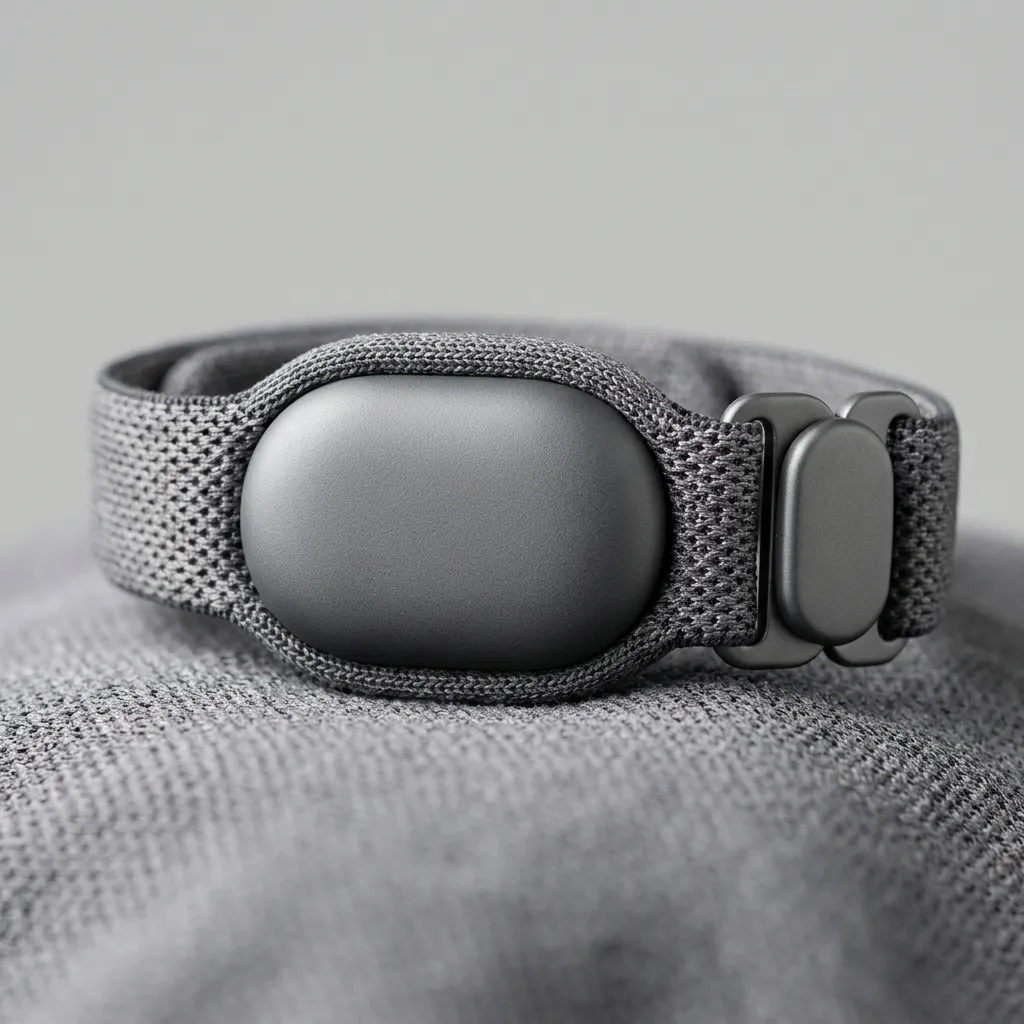
Matte PA12 nylon pebble-form actuator capsule nestled seamlessly in an ergonomic breathable pelvic band with quick-release magnetic clasp. Engineered for zero cogging torque, acoustic silence, and complete anatomical freedom.
Maxon EC 90 / ODrive Testbed
High-torque motor (4.4 Nm peak) paired with ODrive ESC for physical bench characterization, adult trunk stabilization trials, and dynamic balance bike stabilization testing.
6 Clinical Operational Modes
The embedded control firmware supports 6 dedicated operational modes, coordinated between the thoracic Hub and bilateral Actuators. To maintain clean architectural boundaries, comprehensive therapeutic rationales and clinical protocols reside in the Clinical Overview hub.
Rigorous Clinical Safety Architecture
Controlled Exponential Washout
Upon packet loss or heartbeat timeout, motor torque decelerates along a calibrated exponential curve, preventing sharp angular momentum backlash into pediatric spinal segments.
Active Low-Side Dynamic Braking
If the link remains unrecovered, the inverter engages low-side FET dynamic braking to safely dissipate kinetic energy from the reaction wheel rotor before power disconnection.
Independent MOSFET Power Cut
The independent hardware watchdog cuts gate drive to the power bus, mechanically isolating the battery via high-side MOSFETs and blowing the 7.5A blade fuse if overcurrent persists.
Continuous Spectral Fatigue Attenuation
Enforces a hard limit of max 40 impulses per 2-minute rolling window, continuously monitoring patient tremor frequency to prevent muscle exhaustion.
Software-in-the-Loop (SITL) MuJoCo Physics
Uncompromised first-principles physics validation linking native C++ firmware loops with high-fidelity robotic simulations.
Virtual Proving Ground Before Clinical Trials
Mitti's native firmware code is compiled directly as an x86/ARM host binary that communicates via real-time UDP packets with a MuJoCo multi-body physics simulation.
- •Humanoid Standing Balance: Evaluates active trunk stabilization under external perturbations and simulated hypotonia.
- •Balance Bike Dynamic Damping: Validates roll-axis stabilization on moving pediatric balance bikes.
- •Automated Parameter Sweeps: Validates motor saturation, inertia sizing, and thermal profiles across 30+ simulated scenarios.
1-DoF Inverted Pendulum validation: SITL simulated kinematics vs. physical bench telemetry.
Interactive 60 Hz Browser Physics Sandbox
Inject lateral perturbations, test Trapezoidal DMI assistive torque cues, and observe 3-stage graduated failsafe washout across clinical pathology profiles in real time.
Interactive Real2Sim & Trapezoidal DMI Physics Sandbox
Simulate pediatric trunk posture under lateral perturbations. Compare delayed CNS reflex loops (CMT1B 200ms vs Hypotonia 50ms), active reaction-wheel momentum exchange, and 3-stage graduated failsafe washout in real time.