Active Kinesthetic Cueing & DMI Alignment
Engineered in close collaboration with pediatric physiotherapists to stimulate neuroplasticity and active postural reflexes without rigid immobilization.
Active Kinesthetic Cueing (BalanceImpulse)
During physical therapy, skilled clinicians rarely hold a child firmly or immobilize their joints. Instead, they apply minimal, targeted tactile pressure at key anatomical landmarks (pelvis, thoracic spine) to prompt the child's central nervous system to actively recruit stabilizing trunk musculature.
Mitti translates this clinical facilitation into ungrounded reaction wheel torque impulses with asymmetric sawtooth profiles (BalanceImpulse). Brief corrective impulses stimulate the child's proprioceptive reflex arc rather than creating mechanical dependency, enabling authentic neuroplastic motor learning.
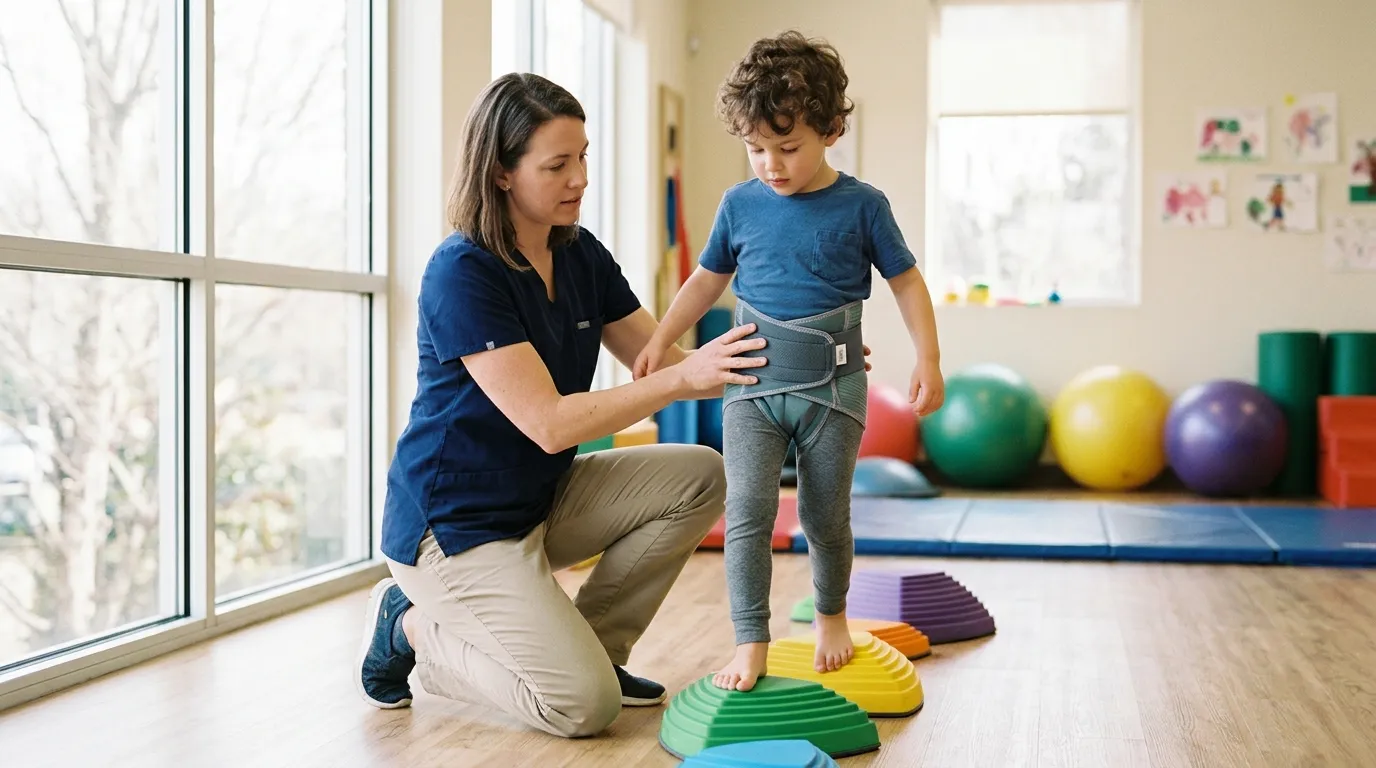
Dynamic Movement Intervention (DMI) tactile facilitation and active postural response
Pediatric Neuromuscular Pathophysiology & Sensory Deficits
Detailed clinical rationale addressing peripheral demyelinating neuropathies (CMT1B), expanded 200 ms reflex conduction delays, generalized hypotonia, and non-actuated Real2Sim baseline identification.
CMT1B (MPZ) Demyelination & 200 ms Reflex Latency
Charcot-Marie-Tooth Type 1B results from autosomal dominant mutations in Myelin Protein Zero (MPZ), producing severe peripheral demyelination. Nerve conduction velocities fall below 10–25 m/s (vs. normal ≥50 m/s), expanding sensorimotor reflex loops to ~200 ms.
Trapezoidal DMI Pulse Shaping:
Instantaneous step impulses trigger secondary stretch-reflex recoil because delayed motor responses arrive after torque has ceased. Mitti’s 50 ms jerk-limited ramp (dT/dt ≤ 30 Nm/s), 150–300 ms sustained plateau, and 100 ms controlled ramp-down bridge this 200 ms latency window.
Generalized Hypotonia & Axial Postural Collapse
Generalized muscular hypotonia presents with substantially diminished resting muscle tone, ligamentous laxity, and compromised proprioceptive feedback. When upright, children experience compensatory trunk slumping, anterior pelvic tilt, and secondary spinal curvature.
Assist-as-Needed Neuromuscular Trigger:
Rather than locking the skeleton in rigid plastic, minimal kinesthetic cues (≤ 1.5 Nm) trigger vestibular self-correction. Axial muscle fibers fire actively, preventing the severe muscle disuse atrophy caused by conventional passive orthotics.
Non-Actuated LOGGING Mode & Real2Sim Identification
Prior to applying closed-loop torque, patient-specific MuJoCo physics models are identified under a strict "No Sim Cheating" discipline using passive LOGGING mode.
With motors unpowered (τ = 0.0 Nm), natural dual-IMU sway kinematics are collected to parameterize individual body segment masses, joint damping, and neural reflex delays at t = 0.
- G1–G4 Telemetry Hierarchy: Raw IMU dynamics (G1) segment into gait events (G2) and atomic corrective primitives (G3).
- 0.2× Habituation Downweighting (G4): Progress metrics downweight passive slumping (0.2×) while rewarding active neuromuscular recovery (1.0×).
- Longitudinal Neuroplasticity Proof: Tracks decreasing impulse frequency over therapy weeks.
The 6 Canonical Clinical Operational Modes
Imported directly from centralized clinical data models. Each mode specifies actuation profiles, quantitative latency targets, and therapeutic neuroplasticity objectives.
Logging
Baseline postural kinematic and gait data collection without motor intervention, providing uncorrupted natural movement metrics.
Therapy
Dynamic intermittent corrective impulses with refractory rest periods that trigger the patient's own proprioceptive reflex arc rather than creating mechanical dependency.
Autonomy
Continuous assistive balance stabilization for sustained upright posture during high-challenge functional tasks, scaling torque down as user stability improves.
Bike
Velocity-dependent angular damping tailored for pediatric balance bike riding, suppressing high-frequency steering wobble and sudden roll collapses.
Scoliosis
Asymmetric corrective torque modulated by differential inclination between thoracic and pelvic IMUs, discouraging lateral trunk collapse while preserving respiratory excursion.
Gait-Rhythm
Alternating left-right tactile cueing synchronized to the child's walking cadence, guiding symmetric step timing and pelvic weight-shift initiation.
Mechatronics, Control Loops & Safety Governance
Looking for real-time 100 Hz closed-loop control diagrams, Dual-IMU APA intention gating, the 6-module hardware architecture, or the 3-stage graduated failsafe?