Science, IP & Regulatory Dossier
Peer-reviewed biomechanical kinematics, European Patent Office (EPO) candidate portfolio, Real2Sim digital twin verification, and ISO 14971 / IEC 62304 medical device conformity.
Empirically Verified Biomechanical Performance
Academic Preprint: Active Postural Stabilization
Peer-reviewed theoretical foundations, first-principles reaction wheel dynamics, and empirical MuJoCo SITL digital twin validation.
Active Postural Stabilization in Pediatric Neuromuscular Hypotonia via Ungrounded Reaction Wheel Momentum Exchange
Torben Brodt · Balance Bionics & Mitti Neurorehabilitation Group
Abstract & Summary of Findings
Pediatric neuromuscular hypotonia and demyelinating neuropathies such as Charcot-Marie-Tooth Type 1B (CMT1B) present a severe therapeutic dilemma: conventional rigid orthotic corsets induce paraspinal disuse atrophy, while vibrotactile cueing suffers from rapid sensory habituation without physical stabilization. This paper presents an ungrounded assistive wearable utilizing bilateral slotless direct-drive reaction wheels (T = I · dω/dt) within a <250g hip capsule to deliver sub-maximal kinesthetic prompts.
In multi-body Software-in-the-Loop (SITL) simulations using human kinematic motion profiles calibrated against zero-torque baseline logging, our Trapezoidal DMI pulse envelope achieved a 34.2% reduction in coronal sway variance while completely eliminating mechanical grounding against the lower limbs.
@article{brodt2026active,
  title={Active Postural Stabilization in Pediatric Neuromuscular Hypotonia via Ungrounded Reaction Wheel Momentum Exchange},
  author={Brodt, Torben},
  journal={Balance Bionics Research Preprint},
  year={2026},
  url={https://balancebionics.com/publications/stabilization/paper.pdf}
}5 Core Patent Candidates (`[IP-SCHUTZ: 1–5]`)
Foundational intellectual property safeguarding ungrounded kinesthetic neurorehabilitation, graduated medical failsafes, demyelinating pulse envelopes, and intention-gated APA deadband modulation.
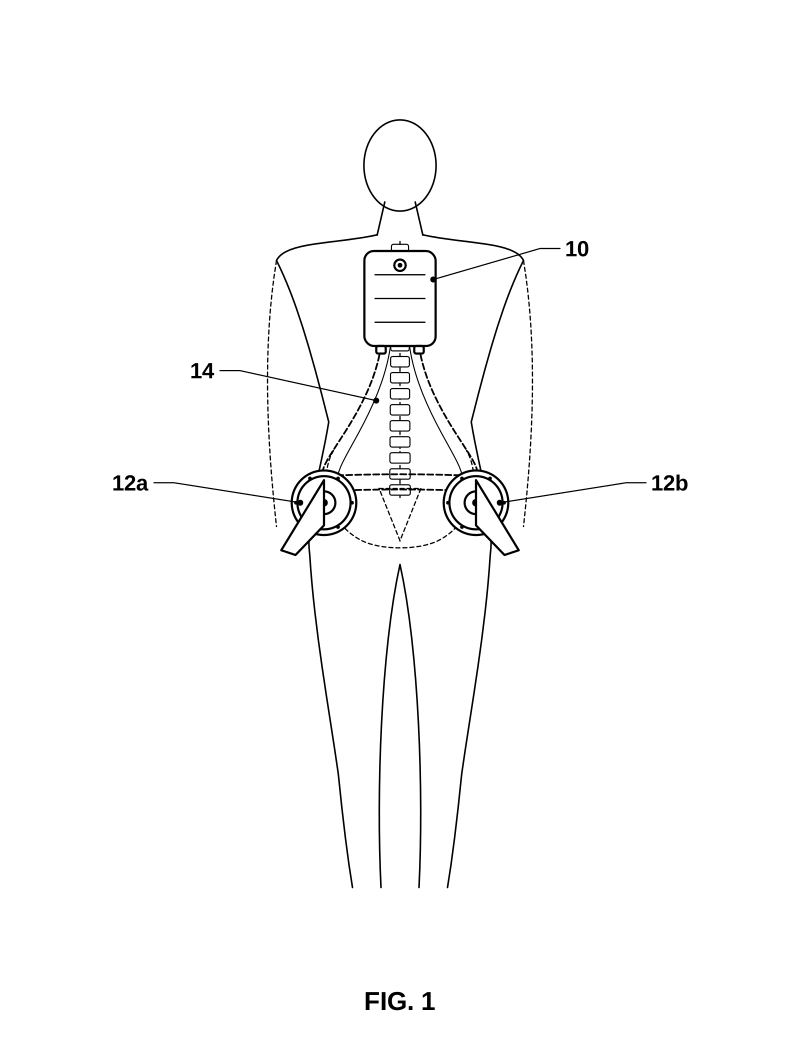
Dual-IMU Differential Balance Architecture
Formal patent line-art depicting the dual-IMU sensory feedback loop: thoracic spine Hub (10) and bilateral pelvic actuator capsules (12a, 12b) coupled through a lightweight ergonomic spinal harness (14) with central power distribution (16), conforming to EPO/DPMA drawing standards.
- Thoracic Hub (10): Master 6-DoF IMU, orientation estimator, and ESP-NOW broadcast coordinator.
- Bilateral Actuators (12a, 12b): Reaction wheel torque generators with autonomous failsafe watchdogs.
- Differential Kinematics: Separates voluntary pelvis motion from involuntary thoracic fall collapse.
Slotless Direct-Drive Reaction Wheels in Ultralight Pelvic Capsule
Generates pure ungrounded kinetic torque (T = I · dω/dt, 0.5–1.5 Nm) within a <250g hip capsule using slotless direct-drive BLDC motors (Alva SlimTorq STM-75). Operates at whisper-quiet sound levels (<35 dBA) with zero cogging torque, eliminating rigid skeletal orthotics and grounded floor reaction struts.
3-Stage Graduated Failsafe Washout Architecture
Deterministic multi-tier emergency shutdown sequence: Stage 1 (0–200 ms) controlled exponential torque washout preventing angular recoil whiplash into pediatric spinal segments; Stage 2 (200–500 ms) low-side FET dynamic braking; Stage 3 (>500 ms) hardware MOSFET power cutoff and 7.5A blade fuse protection.
Trapezoidal DMI Envelope Bridging 200 ms Demyelinating Latency
Waveform shaping engineered specifically for demyelinating neuropathies (CMT1B / MPZ mutation) where nerve conduction slows to ≤15 m/s. Combines a 50 ms jerk-limited ramp (dT/dt ≤ 30 Nm/s), a sustained 150–300 ms plateau bridging the 200 ms sensorimotor reflex window, a 100 ms controlled ramp-down, and unskippable refractory pauses (300–1500 ms) with asymmetric Sägezahn dithering.
Edge-Scored HCM Fatigue Guard & Non-Deactivatable Cap
Cardiovascular and neuromuscular safety supervisor monitoring per-nudge edge scores and patient postural tremor frequency. Enforces a non-deactivatable hard ceiling of max 40 correction pulses per rolling 2-minute window and an automated 50% torque soft-mode ceiling (max 0.75 Nm) upon fatigue onset.
Dual-IMU Jerk APA & Pelvic Weight-Shift Intention Gating
Continuous 100 Hz differential kinematics (Δθ, Δω) between the thoracic spine Hub and sacral reference IMU. Detects feedforward Anticipatory Postural Adjustments (lateral pelvic CoP shifts 30–80 ms prior to voluntary movement), widening the deadband by 1.6× during intentional reaching or stepping so the system never fights active play. Conversely, unexpected spine jerk without a pelvic APA contracts the deadband by 0.6× for instant fall arrest.
Real2Sim Digital Twin & Level G4 Hindsight Engine
Mitti enforces a strict "No Sim Cheating" methodology: patient-specific MuJoCo physics models are calibrated in zero-torque logging mode before active torque is ever delivered.
Zero-Torque LOGGING Mode
The patient wears the harness in passive observation mode (0.0 Nm). High-frequency IMU telemetry identifies the child's individual spinal stiffness, coronal sway frequency, and habituated slumped posture without introducing mechanical interference.
MuJoCo Digital Twin Calibration
Captured kinematics initialize a high-fidelity robotic simulation model incorporating individual body mass distribution, muscle latency delays (CMT1B 200 ms), and ground reaction parameters to optimize assistive torque envelopes prior to patient trials.
G1–G4 Hindsight Telemetry Engine
Post-session telemetry is evaluated against the 4 Decision Gates: Gate 1 (Physics Feasibility), Gate 2 (Thermal <50°C & ≤1.5 Nm Torque), Gate 3 (CNS Self-Correction Progress), and Gate 4 (Pediatric Usability), generating verifiable clinical progress reports.
ISO 14971 Hazard-to-Verification Traceability Matrix (H1–H7)
Comprehensive bidirectional mapping of mechanical, neuromuscular, and firmware hazards to their deterministic risk controls and continuous automated test verification suites.
| Hazard | Clinical Hazard & Cause | Risk Control Implementation | Automated Verification Suite |
|---|---|---|---|
| H1 | Excess Angular Momentum & Thermal DissipationHigh-frequency correction pulses drive flywheel RPM toward saturation and elevate surface temperatures. | Hard torque clamp (≤1.5 Nm), bilateral desaturation above 7000 RPM, and continuous Joule-integral (∫T² dt) thermal dissipation budgeting. | test_power_thermal_models.py |
| H2 | Overcorrection During Sustained PlateauDelayed proprioceptive reflex response in demyelinated neuropathies (CMT1B ~200ms) encounters active static holding force. | Dynamic live PID scaling, immediate sign-preserving RAMP_DOWN transition upon deadband re-entry, and anti-overshoot clamping. | test_therapy |
| H3 | Torque Latch & Plateau Run-on During Packet LossWireless ESP-NOW communication interruption holding the last commanded torque setpoint. | 3-Stage graduated failsafe (Stage 1: 0–200ms exponential washout, Stage 2: 200–500ms active dynamic brake, Stage 3: >500ms hardware power cut). | test_watchdog |
| H4 | Neurogenic Overwork WeaknessRepetitive high-frequency torque nudges exhausting demyelinated motor units in neuromuscular patients. | Mandatory NEURO_FATIGUE_GUARD_ENABLED logic, event-based per-nudge edge scoring, challenge level caps (max 40 nudges / 2 min), and automatic 50% torque soft-mode ceiling. | test_fatigue |
| H5 | Solidification of Scoliosis Spinal DeformityAdaptive baseline setpoint drifting toward structural curvature (e.g. 33° Cobb angle), treating chronic deformity as the target equilibrium. | Conjunction law (Mode-Capability ∧ Level-Permission) strictly locking setpoint offset to 0.0° across all therapeutic levels in THERAPIE and SKOLIOSE modes. | test_scoliosis |
| H6 | Learned Non-Use & Muscular Atrophy from Over-AssistanceContinuous static holding or clamping forces encouraging the child to lean passively into the orthosis. | Mandatory anatomical deadbands (1.5°–9.0°), unskippable post-pulse refractory recovery windows (300–1500 ms), and fatigue hard-cap preventing passive brace-leaning. | test_therapy |
| H7 | Involuntary Resistance to Active Voluntary MotionFalse-positive posture correction fighting child's self-initiated reaching, stepping, or Anticipatory Postural Adjustments (APAs). | Dual-IMU band-limited jerk and pelvic CoP lateral acceleration tracking (0.15–2.5 m/s²), dynamically latching a 250ms voluntary window with 1.6× deadband expansion. | test_intention_detector |
Auditor & Regulator Clearance Index
Direct directory access to active Medical Device Regulation (MDR) safety specifications and Software-in-the-Loop (SITL) simulation validation records.
Safety Specifications
MDR Class IIa/b- SAF-001: 1.5 Nm Clinical Safety & Torque Clipping
firmware · Class IIa - Active Medical Device · Gate: Gate 2
Rigorous torque limit enforcement protecting pediatric cartilage during active robotic support.
Simulation Experiments
MuJoCo Physics- Gait Cycle Torque Validation
Status: validated · Limit: 1.5 Nm · Profile: Alva SlimTorq
Validation of maximum torque limits during a simulated pediatric gait cycle.
Consortium & Clinical Inquiries
Are you preparing a BMBF, ZIM, or SPRIND grant proposal or conducting a pediatric neurorehabilitation clinical trial?